

If you think a smart curtain motor is just a luxury add-on for high-end coastal retreats, you're missing the most significant shift in Australian home automation since the NDIS rollout. For many, these devices aren't just about style; they're essential tools for energy efficiency and independent living. Whether you're managing the summer heat or setting up a Specialist Disability Accommodation (SDA) home, getting the hardware right is critical.
It's common to feel stuck when faced with the technical hurdles of a modern build. You've likely worried about the cost of professional installs or felt confused by the debate between Zigbee 3.0 and the newer Matter 1.5 protocols. With the Cyber Security (Security Standards for Smart Devices) Rules 2025 now in effect as of March 2026, ensuring your gear is SAA-approved and compliant is no longer optional for your insurance or peace of mind.
This guide shows you how to transform your space into an accessibility powerhouse that integrates with Apple Home or Home Assistant. You'll learn how to navigate NDIS assistive technology thresholds and why the latest Thread updates matter for your mesh network. Let's look at achieving a seamless, voice-controlled home that meets every local safety standard and regulatory requirement.
Key Takeaways
- Learn why moving from manual pull-cords to automated tracks is a critical upgrade for both luxury renos and NDIS accessibility.
- Compare Zigbee 3.0 against the Matter 1.5 protocol to choose the right connectivity standard for a responsive smart home.
- See how a smart curtain motor integrated into an SDA home in Point Cook provides life-changing independence for residents.
- Identify why SAA certification and correct GPO positioning are vital for Australian electrical safety and insurance compliance.
- Discover the advantages of trade-focused hardware and how to future-proof your installations with specialised Australian expertise.
What is a Smart Curtain Motor and Why Does Your Aussie Home Need One?
A smart curtain motor is a high-torque motorised drive unit designed to automate the movement of window coverings along a dedicated track. Unlike traditional setups that rely on manual pull-cords, these systems use a drive belt and a wireless receiver to translate digital commands into physical motion. This shift from manual to automated control is a game-changer for modern home automation systems, allowing you to operate heavy blockout curtains via voice commands or smartphone apps.
In the Australian climate, these motors are more than just a convenience. They provide a "set and forget" solution for home security and climate management. You can schedule your curtains to open and close at specific times, giving the impression that someone is home even when you're away on holidays. This automation also eliminates the safety risks associated with looped cords, which is a vital consideration for families and NDIS-compliant housing builds.
The Anatomy of a Motorised Track System
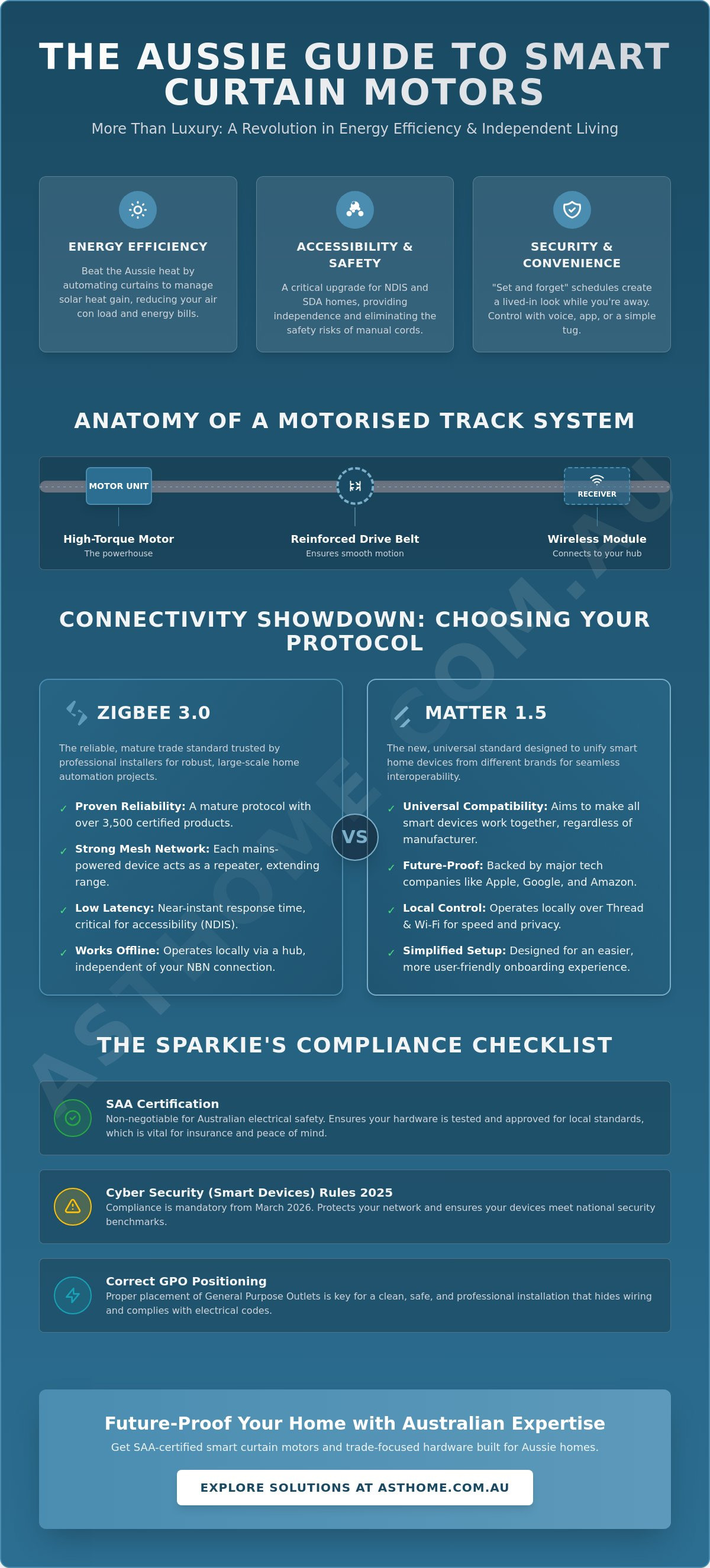
A professional-grade system consists of three main components: the motor unit, the reinforced drive belt, and the wireless receiver. While rod-based drivers sit on top of existing poles and push the rings along, track-integrated motors are far superior. They're concealed behind the curtain heading and offer a much higher weight capacity for heavy Aussie blockouts. Most premium units also feature "Touch Start" technology. This allows you to trigger the smart curtain motor by simply giving the fabric a gentle tug, which is perfect for guests who aren't familiar with your voice controls.
Energy Efficiency: Beating the Australian Heat
Energy prices and soaring summer temperatures make thermal regulation a priority for every homeowner. Automated sheers can be programmed to close during peak UV hours, significantly reducing solar heat gain before it warms up your living space. By integrating a Smart Temperature and Humidity Sensor, your system can react to the environment in real-time. If the western sun hits a certain threshold, the curtains close automatically, protecting your furniture and reducing the load on your air conditioning.
Thermoregulation via smart curtains is the automated process of controlling solar heat gain by adjusting window coverings based on time of day or ambient temperature.
Using a smart curtain motor ensures your home stays cool during a January heatwave without you having to lift a finger. It's a proactive approach to energy efficiency that pays for itself through lower utility bills and increased comfort. Whether you're retrofitting a Victorian terrace or finishing a new build in Point Cook, these systems provide the technical edge required for 2026 standards.
Zigbee 3.0 vs. Matter: Choosing the Right Protocol for Your Reno
Deciding on a communication protocol is the most technical hurdle in any Australian renovation. While Wi-Fi is fine for a single light bulb, a whole-home setup requires a more robust mesh network. This is where the choice between Zigbee 3.0 and the Matter smart home protocol becomes critical. For a smart curtain motor, the protocol determines how quickly it responds to your voice and whether it keeps working when your internet provider has a service outage.
The "offline" fear is a real concern for many Aussie homeowners. If the NBN drops out, cloud-dependent devices stop dead. However, both Zigbee and Matter operate locally. By using a Zigbee Gateway Hub, your devices communicate directly with each other within the four walls of your home. This ensures your curtains still close at sunset, regardless of your external internet connection.
Zigbee 3.0: The Reliable Trade Standard
Professional installers and sparkies often lean towards Zigbee for larger projects. It is a mature technology with over 3,500 certified products available as of 2026. Because it operates on a dedicated mesh, each mains-powered device acts as a repeater, strengthening the signal across your house. This low-latency performance is vital for accessibility needs where a three-second delay isn't just annoying; it's a failure of the system. Zigbee motors also boast superior battery life because the protocol is incredibly power-efficient compared to standard Wi-Fi. This makes them ideal for retrofitting where pulling new cables isn't an option.
Matter: Future-Proofing Your Smart Home
Matter 1.5 is the new industry standard designed for total interoperability. If you have an iPhone but your partner uses an Android, a Matter Smart Switch or motor allows both ecosystems to control the same hardware without a struggle. Matter often runs over Thread, a network layer that provides the same mesh benefits as Zigbee but with even faster pairing. It simplifies the setup process for non-technical users by using a simple QR code scan to join the network.
While there are fewer Matter-certified products (roughly 1,100 in early 2026) compared to Zigbee, the industry is shifting rapidly in this direction. Thread is the "road" the Matter "language" travels on, providing a low-power, reliable network for your smart curtain motor. If you're looking to build a unified system, check out our range of Matter-compatible hardware to ensure your gear remains relevant for years to come. This approach allows you to mix and match brands while keeping the user experience simple and responsive.
Case Study: Automating a Point Cook SDA Home for NDIS Compliance
In a recent Specialist Disability Accommodation (SDA) project in Point Cook, Victoria, the design team faced a significant accessibility hurdle. The resident, who has limited upper-limb mobility, found it impossible to manually operate the heavy floor-to-ceiling blockout curtains required for sleep and thermal comfort. This isn't just a matter of convenience. For an NDIS participant, the inability to control their environment directly impacts their autonomy and increases daily carer intervention hours.
The solution involved installing an SAA-certified smart curtain motor on a reinforced track system. By moving away from manual cords, the resident gained full control via voice commands and a wall-mounted tablet. This hardware choice aligns with the NDIS Guide to Assistive Technology, which prioritises tools that foster independence. The outcome was immediate. The resident could manage their own privacy and light levels without waiting for a support worker, effectively reducing the home's operational reliance on manual assistance.
Meeting NDIS SDA Standards
Specifying NDIS SDA smart home technology australia requires a focus on reliability and safety that goes beyond standard retail installs. For this Point Cook home, every motor had to feature a manual override. This ensures that in the event of a power failure or system glitch, a carer can still move the curtains by hand without damaging the drive belt. We also integrated the curtains with motion sensors. This allows the curtains to close automatically at dusk, which simultaneously triggers low-level path lighting to prevent falls during the night.
Installation Workflow for Accessibility
Successful automation in an SDA environment follows a methodical trade-led process. It's not a simple DIY job. The Point Cook build followed these four critical steps:
- Step 1: Structural reinforcement of the pelmets. Motorised tracks carry more weight and exert different torque forces than manual rods, so solid fixing points are essential.
- Step 2: Installing General Power Outlets (GPOs) at the curtain head. A permanent 240V supply eliminates the need for the resident or carer to climb ladders to recharge batteries.
- Step 3: Commissioning the NDIS SDA Smart Home Kit. This involves pairing the smart curtain motor with a local Zigbee gateway to ensure the system remains functional even if the external internet drops out.
- Step 4: Resident training. We spent time setting up specific voice triggers that matched the resident's natural speech patterns, ensuring the technology worked for them, not against them.
Independence is the ultimate goal of any SDA build. By selecting the right hardware and following a compliant installation workflow, builders and sparkies can deliver a home that truly empowers its occupants while meeting all 2026 Australian regulatory standards.
The Sparkie’s Guide: SAA Certification and GPO Placement
For a licensed electrician, the hardware choice for a smart curtain motor project isn't just about functionality. It's about liability and meeting Australian wiring rules (AS/NZS 3000). While DIY-focused competitors might suggest battery-only solutions to avoid electrical work, permanent luxury and NDIS builds require a hardwired 240V supply. This ensures the system is always ready and eliminates the maintenance burden on the end-user.
SAA certification is the benchmark for safety in the Australian market. Using grey-market motors sourced from overseas platforms might save a few dollars upfront, but it voids building insurance and puts your electrical licence at risk. If a non-compliant motor causes a fire, the responsibility falls squarely on the installer. Always look for the Regulatory Compliance Mark (RCM) on all Asthome hardware to confirm the device has passed rigorous local testing.
Why SAA Certification Matters
Grey-market devices often lack the internal insulation and surge protection required for the Australian grid. SAA approval ensures the smart curtain motor can handle our 230V/50Hz supply without overheating. When you specify SAA-certified gear, you're protecting your professional reputation and providing the homeowner with peace of mind. It's a non-negotiable anchor for any trade-led installation.
Retrofitting Smart Motors in Existing Homes
Retrofitting doesn't always mean a full rewire. You can use Zigbee 3.0 Smart Switch Modules to trigger curtain scenes from existing wall switches. For permanent installs, we recommend placing a recessed "hidden" GPO within the pelmet or behind the curtain stack. This maintains a clean aesthetic while keeping the 240V plug accessible for maintenance.
When planning the circuit, remember that most residential curtain motors draw between 30W and 100W during peak operation. You can safely run multiple motorised tracks on a single 10A lighting or power circuit, but always factor in the inrush current. For eaves or external placements, ensure there is a minimum clearance of 50mm for motorised tracks to allow for thermal expansion and airflow.
If you're a licensed professional looking for compliant hardware, explore our trade-ready smart curtain motors to ensure your next project meets every Australian safety standard. Using the right gear from the start saves you a callback and keeps the client's insurance valid.
Future-Proofing Your Home with Asthome Smart Solutions
Choosing a local specialist means you aren't just buying hardware; you're securing a partnership with practitioners who understand the Australian building code. While international platforms offer generic gear, an Asthome smart curtain motor is engineered specifically for our local conditions. Our SAA-certified units are built to withstand the thermal stress of a Victorian summer, ensuring your investment doesn't fail when you need it most. This commitment to quality provides the peace of mind that trade professionals and homeowners require in a high-stakes industry.
Future-proofing requires a holistic strategy. Don't stop at window coverings. Integrating your curtains with smart light switches and motion sensors creates a responsive environment that manages lighting and temperature simultaneously. This unified approach is what separates a basic gadget setup from a true high-performance smart home. By using a single ecosystem, you reduce protocol conflicts and simplify the user experience for everyone in the household.
The Asthome Trade Advantage
We provide a dedicated resource for those in the industry. Licensed sparkies and NDIS builders can access trade accounts with wholesale pricing, which is essential for maintaining margins on large-scale SDA projects. Our technical support team is based right here in Point Cook, Victoria. We don't just sell boxes; we provide the technical literacy required to ensure every install meets power point (GPO) standards and regional regulatory rules. This peer-to-peer service model ensures you have an expert partner to call when you're on-site and need a quick technical answer.
Getting Started with Your Automation Journey
Measuring for a custom motorised track is a straightforward process but requires precision. Always measure the full width of the window frame plus any desired "stack back" area to ensure the fabric clears the glass when open. You'll also need to decide between S-Fold and Pleated curtain styles. S-Fold tracks are currently the gold standard for a modern look. They provide a consistent wave that hides the smart curtain motor unit perfectly while allowing the fabric to drape naturally.
Whether you're finishing a luxury coastal reno or a compliant accessibility powerhouse, the right hardware makes the difference. Take the next step in your automation journey and View the Asthome Smart Curtain Range to find the right motorised solutions for your next project. Our range is designed by practitioners, for practitioners, ensuring every component meets the highest Australian standards.
Ready to Automate Your Australian Home?
The shift toward automated living isn't just about luxury; it's about building a home that works for everyone. You now understand why choosing the right protocol, like Zigbee 3.0 for mesh stability or Matter 1.5 for cross-platform ease, is the foundation of a responsive system. Integrating a smart curtain motor provides more than just a premium feel. It delivers essential thermoregulation and independence, particularly in SDA builds where accessibility is the top priority.
Safety remains the non-negotiable anchor of any electrical install. By prioritising SAA-certified hardware and professional GPO placement, you protect your property and ensure full insurance compliance. Our team at Asthome supports you with NDIS SDA compliant hardware and local technical support based right here in Point Cook. We're practitioners who understand the specific needs of the Australian trade industry.
Upgrade Your Home with SAA-Certified Smart Curtain Motors
Take control of your home's comfort and security today. It's time to build a space that is as smart as it is safe.
Common Questions About Smart Curtain Automation
How much weight can a smart curtain motor actually pull?
Most professional-grade motors are rated to pull curtains weighing up to 50kg on a standard track. For extra-wide spans or heavy thermal blockout fabrics, high-torque units can support loads up to 100kg. It is vital to match the motor's torque rating to the total weight of your fabric and track length to prevent premature wear on the internal drive belt.
Do I need an electrician to install a smart curtain motor in Australia?
You must engage a licensed electrician to install any 240V hardwired smart curtain motor or to fit new General Power Outlets (GPOs) for plug-in models. Australian wiring rules (AS/NZS 3000) mandate that fixed electrical work be performed by a trade professional to ensure your building insurance remains valid. While battery units are mounting-only, any permanent power solution requires a sparkie.
What happens to my smart curtains if the power goes out?
Your curtains remain fully functional through manual operation during a power failure. Most premium motors feature an electromagnetic clutch that automatically disengages when the power is cut, allowing you to slide the curtains by hand without resistance. Once the power returns, the system recalibrates its end-limits and resumes your saved schedules without needing a manual reset.
Are smart curtain motors noisy during operation?
Modern motorised tracks are engineered for near-silent operation, typically producing sound levels below 35 decibels. This is roughly the same volume as a quiet whisper, making them ideal for nurseries or bedrooms. The high-quality drive belts and dampened motor housings ensure a smooth, low-frequency hum rather than the mechanical grinding sound found in cheaper, non-compliant imports.
Can I still pull my curtains manually with a motor installed?
You can still operate your curtains manually thanks to "Touch Start" technology integrated into the smart curtain motor. A gentle tug on the fabric heading triggers the sensor, and the motor takes over to complete the movement. This provides a natural user experience for guests or family members who might not have access to your smartphone app or voice assistants.
How long does the battery last on a rechargeable curtain motor?
Rechargeable lithium-ion batteries generally last between three and six months on a single charge, based on two full cycles per day. The actual duration depends on the weight of your curtains and how often you trigger the motor. Most units use a standard USB-C charging port, though we recommend hardwired 240V connections for NDIS SDA builds to eliminate the maintenance task of recharging.
Is the Asthome smart curtain motor compatible with Apple HomeKit?
Yes, our motors integrate with Apple Home when used with a Matter-certified gateway or a compatible Zigbee hub. This allows you to use Siri voice commands and create complex automations within the Apple Home app. By using the Matter 1.5 protocol, you ensure your window coverings work seamlessly alongside other HomeKit-enabled devices without the need for unstable third-party workarounds.
Does NDIS funding cover the cost of smart curtain motors?
NDIS funding frequently covers automated curtains under the Assistive Technology (AT) budget if they increase your independence at home. For systems under $1,500, they are typically processed as low-cost AT, while more expensive SDA installations may require a formal assessment from an Occupational Therapist. These devices are life-changing for participants with limited mobility who cannot operate traditional manual cord systems.