

Is that "bargain" smart switch you found online about to void your Australian home insurance? Since the Cyber Security Rules 2025 came into legal effect on March 4, 2026, choosing smart switches for your home renovation isn't just about picking a pretty faceplate. It's about ensuring every component carries the RCM mark and meets strict SAA safety standards. You've probably felt the headache of trying to distinguish between Matter 1.5 and Zigbee 3.0 protocols, or worried that your older home's lack of a neutral wire will stop your automation plans before they even start.
We understand that you want a lighting system that is reliable, legal, and ready for the future. This guide simplifies the technical landscape, from choosing between visible hardware and invisible in-wall modules to ensuring your gear plays nice with HomeKit or Home Assistant. You'll learn how to navigate the latest compliance requirements and find the hardware that can help slash your household energy bills by up to 40%. We're breaking down the shift toward mesh-based protocols and no-neutral solutions so you can upgrade your space with total confidence.
Key Takeaways
- Identify the essential SAA and RCM certifications required to ensure your hardware is legal and insurance-compliant.
- Compare Matter 1.5 and Zigbee 3.0 protocols to build a reliable mesh network that stays local and lightning-fast.
- Solve the common "no-neutral" wiring hurdle found in older Australian homes using specialised retrofit modules.
- Decide between discrete in-wall modules or full-faceplate smart switches to suit your specific renovation style.
- Learn how to scale from a single smart GPO to a high-reliability NDIS SDA compliant smart home kit.
The Evolution of Smart Switches in Australia for 2026
The definition of a modern smart home has shifted. In 2026, smart switches are no longer just about flicking a light on from your phone while you're at the office. They represent a sophisticated bridge between traditional tactile control and logic-based digital automation. This evolution focuses on local control, moving away from the "cloud-first" approach that defined the last decade. Practitioners now prioritise hardware that functions even if the NBN drops out, ensuring your home remains operational during an outage. This reliability is rooted in the advancement of wireless light switch technology, which has matured into a robust trade-grade solution.
Homeowners, particularly in growing suburbs like Point Cook, are increasingly opting for "invisible" smarts. Instead of replacing beautiful designer faceplates with generic plastic smart buttons, they're installing hidden modules behind existing switches. This preserves the home's aesthetic while adding advanced dimming and scheduling capabilities. However, with this rise in popularity comes a stricter regulatory landscape. Every device must meet Australian SAA requirements and carry the RCM mark. Under the Cyber Security Rules that came into effect in March 2026, using uncertified hardware isn't just a safety risk; it's a legal liability that can void your home insurance.
Why Traditional WiFi Switches are Fading
Standard 2.4GHz WiFi was the entry point for home automation, but it's hitting a wall. Most home routers struggle to manage the congestion caused by dozens of individual smart switches competing for bandwidth with laptops and streaming devices. This lead to the "cloud lag" problem, where a simple command takes two seconds to process through an overseas server before the light actually turns on. Security is another major factor. Generic WiFi imports often lack the firmware updates needed to comply with Australia's 2026 cyber security standards, making them vulnerable to exploits and local network instability.
The Shift Toward Matter and Zigbee Protocols
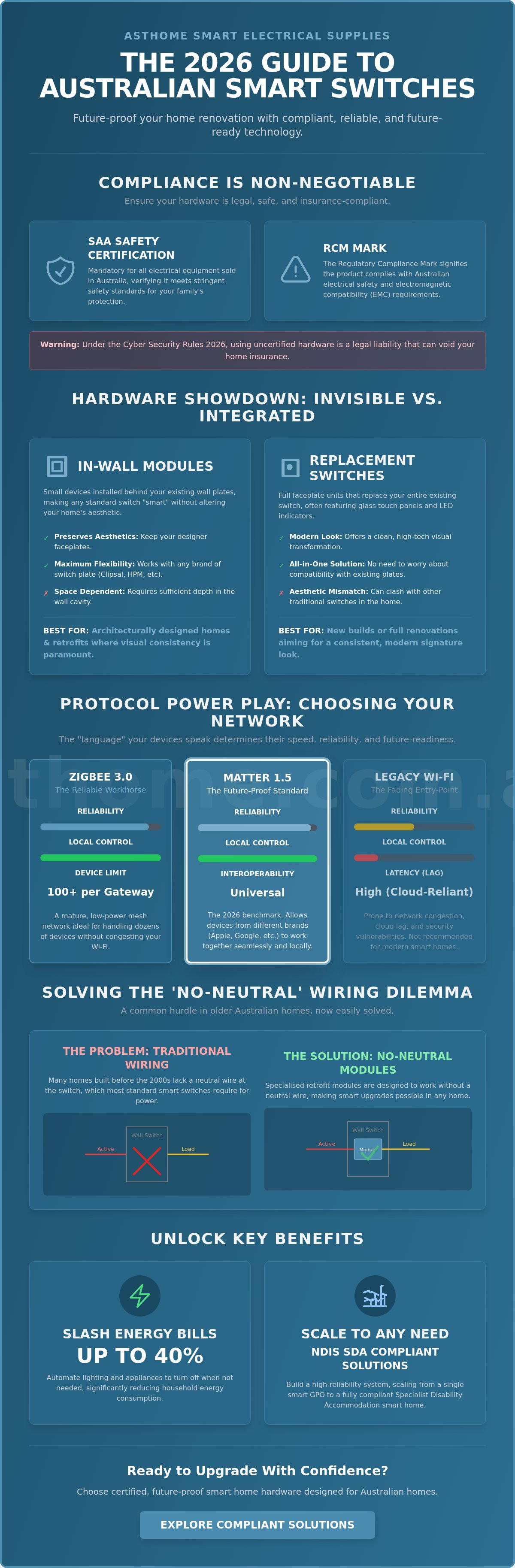
The trade industry has moved toward local mesh networking to solve latency and reliability issues. Zigbee 3.0 remains a staple for its low power consumption and ability to handle over 100 devices through a single gateway. However, Matter 1.5 is the new benchmark for 2026. It allows for seamless interoperability, meaning your hardware works across Apple Home, Google Home, and Alexa simultaneously without complex bridges. Choosing Matter smart switches is now the standard recommendation for any high-end renovation, providing a future-proof foundation that prioritises speed and local privacy over external cloud dependencies.
In-Wall Modules vs. Complete Smart Switch Replacements
Choosing the right hardware for your renovation often comes down to a single question. Do you want your home to look smart, or do you want it to act smart? In Australia, the "Retrofit" debate is a major consideration for homeowners. You can either perform a total overhaul with new faceplates or keep your current aesthetic by using in-wall modules. For high-end architecturally designed homes, aesthetic consistency is paramount. Mixing a sleek, modern glass touch plate with traditional plastic switches in the hallway ruins the visual flow. This is where modules win. They hide behind your existing hardware, providing a seamless finish that doesn't scream "tech."
Smart Switch Modules: The Invisible Upgrade
Modules are the preferred choice for practitioners who value flexibility. These small devices sit inside the wall cavity, tucked behind your existing Clipsal, HPM, or PDL plates. You maintain the tactile, manual feel of a physical switch while gaining full digital automation. This approach is ideal for a Zigbee 3.0 smart switch module Australia retrofit project. It allows you to keep your house looking exactly as it did before, but with the added benefit of local mesh networking. Your sparky will need to ensure there's enough depth in the wall box, especially in older homes with shallow cavities. Using modules also means you don't have to hunt for matching 4-gang plates, as the "smarts" stay hidden away.
Replacement Smart Switches: The Modern Look
Full replacement smart switches offer a complete visual transformation. These units typically feature glass touch plates and LED-backlit buttons. They're a popular choice for new builds where you're starting with a blank canvas and want a high-tech signature look. However, they come with limitations. Finding replacement plates that match a 4-gang configuration can be difficult. If you have a row of four switches, a single smart plate might look out of place next to standard ones. When planning a new build, ensure your hardware follows the Matter connectivity standard to prevent brand lock-in and ensure your home remains compatible with future device releases.
In a standard 3-bedroom Aussie home, the cost-benefit analysis usually favours modules for retrofits. You save on the price of high-end replacement plates while gaining identical functionality. Installation complexity is similar for both. Your electrician must handle the 240V wiring regardless of the form factor. Modules require a bit more "finesse" to fit into tight wall boxes, while full replacements require careful alignment to ensure the new plates sit flush against the plaster. If you're looking to start your journey, consider our range of certified smart switches and modules to ensure your installation meets local safety standards and provides the reliability your home deserves.
Choosing Your Protocol: Zigbee, Matter, or Wi-Fi?
The protocol you select is the backbone of your automation system. It determines how fast your lights respond and how many devices your network can handle before it crawls to a halt. While Wi-Fi 7 is the current standard for high-bandwidth tasks like streaming, it's often the wrong choice for smart switches. A standard home router can become overwhelmed when dozens of switches compete for a connection. This leads to dropped signals and frustrating delays. For a reliable whole-home setup, practitioners prioritse mesh networks like Zigbee and Matter over Thread, which move the heavy lifting away from your primary Wi-Fi router.
In a mesh network, every mains-powered device acts as a repeater. If a switch in the back bedroom is too far from the hub, it simply passes its signal through the switch in the hallway. This creates a self-healing web of connectivity that grows stronger with every device you add. To manage this traffic, you'll need a dedicated gateway. A high-quality Zigbee Gateway Hub can typically manage up to 128 devices, with professional-grade units supporting over 200. This ensures your lighting remains snappy and responsive, regardless of how much Netflix is being streamed in the lounge room.
Zigbee 3.0: The Proven Workhorse
Zigbee 3.0 remains the most stable and widely adopted choice for Australian lighting in 2026. It's a low-power, high-reliability protocol that has been refined over decades. Because it operates on a separate frequency range from your heavy Wi-Fi traffic, it avoids the interference that plagues cheaper setups. The secret to a successful Zigbee installation is choosing a high-quality smart home hub. This central brain handles the local logic, ensuring your "all lights off" command happens instantly, even if your internet connection is down. It's the "set and forget" option for those who value trade-grade reliability.
Matter over Thread: The Future-Proof Choice
Matter 1.5 has changed the game for interoperability. It's a unifying language that allows hardware from different brands to talk to each other without proprietary bridges. For Apple HomeKit and Google Home users, Matter is essential because it provides native, high-speed control. While Zigbee requires a specific gateway, Matter over Thread uses "Border Routers" to bridge your devices to your home network. If you're running a complex house with a mix of legacy and new tech, you might consider using Homey to bridge multiple protocols. This allows your smart switches to trigger actions across your entire ecosystem, regardless of whether the hardware uses Zigbee, Matter, or Wi-Fi.
The No-Neutral Dilemma and Australian Wiring Standards
If you live in a house built before the early 2000s, you'll likely face the "no-neutral" hurdle. Standard Australian light switches from this era were often wired with only an active and a load wire. Most modern smart switches require a neutral wire to power their internal radios and processors. Without it, the switch can't stay connected to your Zigbee or Matter network when the lights are off. You have two choices. You can pay a sparky to pull new neutral wires through your wall cavities, or you can use hardware specifically engineered for no-neutral environments.
In Australia, all mains-wired electrical work must be performed by a licensed electrician. This isn't just a safety recommendation; it's the law under AS/NZS 3000. Attempting to install these modules yourself is dangerous and will void your product warranty. A professional installer ensures the circuit is balanced and that the physical installation meets the rigid standards required for Australian homes. This is particularly vital when dealing with older switchboards that may require safety switch upgrades before new automation hardware is added.
Working with Older Australian Wiring
Identifying whether you have a neutral wire at the switch is the first step for any retrofit. If your sparky opens the wall plate and finds only two wires, you'll need a no-neutral module. These devices stay powered by "leaking" a tiny amount of current through the light circuit. However, high-efficiency LED globes have a very low minimum load. This can cause the lights to flicker or glow dimly even when switched off. To fix this, you can install a bypass at the light fitting to stabilise the current. Alternatively, choosing a dedicated Zigbee or Matter module designed for no-neutral setups ensures a more reliable connection without the headache of flickering LEDs.
SAA Certification: Non-Negotiable Safety
Compliance is your primary shield against insurance and safety risks. Every 240V device sold in Australia must carry the Regulatory Compliance Mark (RCM) to prove it meets SAA safety standards. Buying uncertified modules from international marketplaces is a massive gamble. These products often lack the internal surge protection and flame-retardant materials required by local law. If a non-compliant switch causes a fault, your home insurance provider can legally deny your claim. SAA certification is the primary legal requirement for all 240V smart hardware in Australia. To protect your home and family, always source certified smart switches and modules from a reputable Australian supplier who understands local regulatory requirements.
Implementing Smart Switches: From Single GPOs to NDIS Solutions
Starting your automation journey doesn't require a total home overhaul from day one. Many homeowners begin by automating a single entry light or a high-traffic zone. Installing smart switches in the hallway or front porch, paired with a smart motion sensor, provides immediate security and utility. Once you've established a reliable Zigbee or Matter gateway, you can scale the system by adding a smart power point (GPO) in the kitchen or a smart dimmer module in the lounge. This modular approach allows you to build a sophisticated system at your own pace while keeping your initial investment manageable.
Scaling up involves moving beyond simple on-and-off commands toward logic-based scenes. A "Welcome Home" scene can be triggered by your smart door lock, which then signals your smart switches to illuminate the entry and your smart curtain motor to close the tracks for the evening. This level of integration requires high-quality, SAA-certified hardware to ensure every component communicates without fail. By expanding from a single room to a whole-home system, you're building a network that works for you, rather than just being a series of remote-controlled gadgets.
Smart Lighting Control for Accessibility
For users with mobility or sensory challenges, this technology is a vital tool for independence. NDIS SDA smart home technology integrates smart switches with voice control and automated scheduling to simplify daily tasks. In a Specialist Disability Accommodation (SDA) setting, these systems must be robust and intuitive. We prioritise the inclusion of manual overrides in our NDIS SDA compliant smart home kits. This ensures that physical control is always available as a fallback, providing peace of mind for both residents and carers. Automated routines, such as lights that dim slowly at bedtime or activate at a low level for night-time pathfinding, significantly improve the living standards for mobility-impaired users.
Professional Solutions for Sparkies
Being a business run by practitioners for practitioners, we understand the specific needs of the Australian trade. Licensed electrical contractors can benefit from bulk pricing and priority support by opening a trade account. Choosing SAA-certified modules and GPOs is the best way to reduce callback rates and protect your professional reputation. When the hardware is built for local conditions, you won't spend your weekends troubleshooting flickering LEDs or dropped connections. Simplifying the handover is also key. By providing your clients with a stable, well-organised system, you're not just installing hardware; you're delivering a future-proof home they can actually manage.
Future-Proof Your Australian Home Automation
Transitioning to smart switches should be a seamless experience that adds value to your lifestyle without compromising on safety. You now understand how the shift toward local mesh networking and Matter 1.5 has redefined reliability for 2026. By selecting hardware that matches your home's specific wiring, whether it's a no-neutral retrofit or a high-end new build, you ensure a system that stays responsive and secure for years to come.
As an Australian owned and operated business based in Point Cook, we're practitioners who understand the local trade landscape. All our hardware is SAA certified to meet rigorous AU standards, ensuring your installation is legal and your insurance remains valid. Licensed sparkies can also take advantage of our dedicated trade accounts for professional support and bulk pricing. Browse our SAA-certified smart switch range and upgrade your home today. We're ready to help you build a more connected and accessible future.
Frequently Asked Questions
Do smart switches work without a neutral wire in Australia?
Yes, specific no-neutral smart switches are available for older Australian homes. These modules are engineered to operate without a neutral wire at the wall plate, though they may require a bypass installed at the light fitting to prevent LED flickering. Your sparky can identify your wiring type during the initial inspection to ensure the right hardware is selected.
Can I install a smart switch myself in Victoria?
No, you cannot legally install a mains-wired switch yourself in Victoria or any other Australian state. All 240V electrical work must be performed by a licensed electrician to comply with AS/NZS 3000. Attempting a DIY installation is illegal, dangerous, and will void your home insurance and product warranties.
Will my smart switches work if the internet goes down?
Yes, your switches will continue to work manually and via local automation if you use Zigbee or Matter protocols. These mesh networks don't rely on an active internet connection for local communication between the switch and the hub. Wi-Fi models may lose app functionality if your router or the cloud service goes offline; however, the physical button remains functional.
What is the difference between a smart switch and a smart globe?
A smart switch controls the entire electrical circuit, allowing you to use any standard globe while keeping your physical wall buttons functional. Smart globes require the wall switch to be permanently switched on to receive power. If someone flicks the physical wall switch off, a smart globe loses its connection and cannot be controlled via apps or voice.
Are Matter smart switches compatible with Zigbee hubs?
Generally no, as Matter switches require a Matter-compatible controller or border router rather than a legacy Zigbee-only hub. While some newer gateways support both protocols, you must verify that your hub specifically lists Matter 1.5 support. Multi-protocol controllers are often used to bridge these different standards into a single interface.
How many smart switches can I have on one Zigbee network?
A standard Zigbee Gateway Hub can typically manage up to 128 devices. High-end professional gateways can support over 200 devices on a single network. Because mains-powered smart switches act as repeaters, adding more switches actually strengthens the mesh network's range and reliability throughout your entire home.
Do smart switches save energy?
Yes, smart switches contribute to lower energy consumption through automated scheduling, remote monitoring, and dimming. 2025 data shows that households using smart lighting control can reduce energy bills by up to 40%. You can further optimise savings by pairing switches with motion sensors to ensure lights are never left on in unoccupied rooms.
What does SAA certification mean for my home insurance?
SAA certification is a legal requirement proving a device meets Australian safety standards. If you install uncertified hardware sourced from overseas, your insurer can legally reject a claim in the event of an electrical fire or fault. Always look for the RCM mark to ensure your property remains protected and your hardware is compliant with local regulations.